Sorry to have been quiet for so long, I'm sure you must have thought that I had been eaten, or perhaps that I had taken eating (others) as a full-time occupation.
Well, you'll be glad to know that I am alive and well... ish. I am also completely alone. My group has abandoned me, they think I'm obsessed with zombie metabolism and that I have completely lost the plot. Well, I'll show them! Ah-hah-hah-haha-HA!
I don't need them! I broke into the biochem labs at Imperial all by myself, and guess what? Their back-up generators have been running this whole time! Partly reliant on solar power - yay for green enthusiasts, though they are sort of brownish-green by now...
Anyway... all the lab zombies were in pretty bad shape, probably the lack of vitamin D, so it wasn't too hard to get myself up and running in one of the labs.
I used to have so much respect for those professor-types, I used to be a PhD student, but it sort of takes the shine off when they dribble from their eyes... They just don't seem to have that same, I dunno, air of authority. Much more an air of rubbish. Eau de crap, if you will.
I digress.
I caught one of the lab zombies, and measured its RER (respiratory quotient, that is, the ratio of oxygen used, vs carbon dioxide produced), and that zombie was respiring veeeeerrrrrryyyyyy sssssllllloooowwwwllllyyyyy. The O2/CO2 was about 0.9, which implies that it is probably using a mixture of carbs and fat, and probably protein too. Would this be different if it had just eaten? There are limits to what I will do in the name of science, so unless I go on a serious revenge kick, I guess we'll never know...
So, what does this have to do with the citric acid cycle? Well, in previous posts, I was debating the importance to zombies of glycolysis (anaerobic) vs fatty acid oxidation (aerobic). Now that I have confirmed that they do use a fair amount of oxygen, it seems highly likely that they will be carrying out citric acid cycle reactions.
For those biochem enthusiasts out there who, despite the daily struggle for survival, despite the lack of edible food, and the numerous walking dead that lie in wait around every corner, never sleeping, never tiring, never feeling satiated in their desire for human flesh, still find a few moments to revise basic biochemistry (metabolism is life!), it is easy to remember why the citric acid cycle is so important.
But for those who have been distracted by the zombiepocalypse, a refresher:
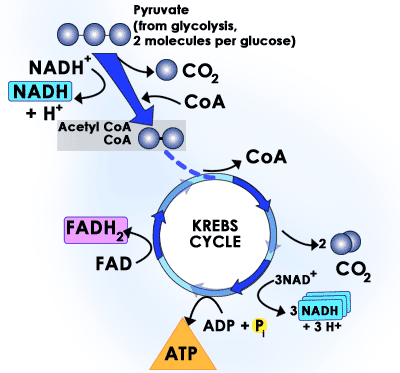
The citric acid cycle takes in acetyl CoA, and via addition of oxaloacetate, oxidises it gradually to carbon dioxide, in a series of reactions that produce, in a roundabout way, energy for the cell. In order to make use of this energy (most of it anyway), the products of the citric acid cycle need to feed into the electron transport chain, which relies on oxygen.
I intend to do more studies on the zombie tissue, in particular the muscle and the nervous system. So guess what is so exciting about zombie research? The tissues continue to work after they have been removed from the body!!!
How cool is that? No more cell cultures for me. (I'm dancing around the lab right now.)
And they thought I was crazy...
Saturday, 18 May 2013
Thursday, 14 February 2013
Zombie Metabolism: Fatty Acid Oxidation
Well, it's got to be done. You can't ignore fatty acid oxidation. It may not be as ancient a pathway as glycolysis, but its where most of the living get there energy. (Especially these days, let's just say, obesity isn't the problem it used to be...)
So, just a quick recap, for those of us who have forgotten what fatty acid oxidation is all about. Which is fair enough I guess, learning how to hotwire cars, pick locks and shoot, doesn't leave much time to revise biochemistry!
Fatty acid oxidation, the pathway which allows us to use fats as fuel, takes place in the mitochondrial matrix, produces shed loads of acetyl CoA, reduced coenzymes, and not much else. The key thing is that, in order to generate any ATP at all, you need oxygen for the electron transport chain and the citric acid cycle. We'll come to these later, if I survive. If I can be bothered.
So, if zombies don't have functioning circulatory systems, can they be carrying out oxidative metabolism? My honest answer - I haven't a clue.
Arguments in favour:
It's hard to believe that they could manage without fat oxidation. Protein reserves and glycogen can only take you so far. In addition, with their diet of mostly entrails, they are eating a lot of fat. And I don't recall seeing any fat zombies, do you? So they must be using it, don't you think?
Arguments against:
But how could they do it without a circulatory system? It just isn't possible to oxidize fats without oxygen? Although its true that they eat a lot of fat, they might use it for something else - the black, viscous fluid that they seem to be full of perhaps?
Theory:
Now this is just completely off the wall thinking, but what if that 'black gunk' is like, concentrated haemoglobin or something? What if the integrity of their tissues is so weak that oxygen just diffuses right through them? I think they can use oxidative metabolism, because they just don't have enough carbohydrates to do without it. And where the tissues are more intact, glycolysis can suffice. Perhaps this is why they rot - to increase aeration in the tissues? Our initial hopes were that they would eventually rot away, but they only decomposed to a certain point, and since then, they haven't changed much. So my theory is that the decomposition only occurred until the damage to the tissues sufficiently increased oxygenation, so that sufficient amounts of oxidative metabolism could occur. I also believe that the dark viscous fluid somehow sustains their metabolism. Perhaps testing their respiratory quotient isn't such a bad idea...
So, just a quick recap, for those of us who have forgotten what fatty acid oxidation is all about. Which is fair enough I guess, learning how to hotwire cars, pick locks and shoot, doesn't leave much time to revise biochemistry!
Fatty acid oxidation, the pathway which allows us to use fats as fuel, takes place in the mitochondrial matrix, produces shed loads of acetyl CoA, reduced coenzymes, and not much else. The key thing is that, in order to generate any ATP at all, you need oxygen for the electron transport chain and the citric acid cycle. We'll come to these later, if I survive. If I can be bothered.
So, if zombies don't have functioning circulatory systems, can they be carrying out oxidative metabolism? My honest answer - I haven't a clue.
Arguments in favour:
It's hard to believe that they could manage without fat oxidation. Protein reserves and glycogen can only take you so far. In addition, with their diet of mostly entrails, they are eating a lot of fat. And I don't recall seeing any fat zombies, do you? So they must be using it, don't you think?
Arguments against:
But how could they do it without a circulatory system? It just isn't possible to oxidize fats without oxygen? Although its true that they eat a lot of fat, they might use it for something else - the black, viscous fluid that they seem to be full of perhaps?
Theory:
Now this is just completely off the wall thinking, but what if that 'black gunk' is like, concentrated haemoglobin or something? What if the integrity of their tissues is so weak that oxygen just diffuses right through them? I think they can use oxidative metabolism, because they just don't have enough carbohydrates to do without it. And where the tissues are more intact, glycolysis can suffice. Perhaps this is why they rot - to increase aeration in the tissues? Our initial hopes were that they would eventually rot away, but they only decomposed to a certain point, and since then, they haven't changed much. So my theory is that the decomposition only occurred until the damage to the tissues sufficiently increased oxygenation, so that sufficient amounts of oxidative metabolism could occur. I also believe that the dark viscous fluid somehow sustains their metabolism. Perhaps testing their respiratory quotient isn't such a bad idea...
Thursday, 17 January 2013
Zombie Metabolism: Glycolysis
Glycolysis
As a pathway, you don't get much more fundamental than glycolysis.Glycolysis, used to break down sugar to produce ATP, is probably used by all living cells - but what about 'unliving' cells? Yes, I am talking about the cells of the living dead, do they carry out glycolysis too?
Let's think about why glycolysis is such an important pathway...
1) The products can be used for synthesis.
2) It doesn't require mitochondria.
3) It doesn't require oxygen.
Point number three, my friends, is probably the important one. I believe that glycolysis is most likely an essential pathway for zombies, and here's why:
NO CIRCULATORY SYSTEM!!!
Zombie bodies show an amazing ability to function despite an incredible level of degradation. The other day, I saw this guy, I kid you not, stabbing a zombie with a sword - wait for it - in the heart! Any idiot knows that zombies don't need their hearts to beat! Even a decapitated zombie head will continue to move its mouth!
But this got me thinking... no blood, no pulse, no circulation. The tissue in these things must be seriously anaerobic! They have to be using glycolysis.
You could argue that the tissue is so badly decomposed that oxygen just diffuses in from the air, and I think that is quite likely, but there is a limit to how far diffusion will go. At the very least, the tissues further in, in particular, the skeletal muscle, must be using glycolysis.
'But wait', I hear you cry (quietly, so the zombies aren't alerted to your presence), 'zombies move slowly, and they never get tired. That sounds like aerobic exercise, which relies mainly on fatty acid oxidation!'
In answer to that, I would like to make three main points:
1) Fatty acid oxidation IS useless for anaerobic exercise, but glycolysis is good for everything!
2) I wasn't saying they only use glycolysis, just that it would play an important role.
3) If you can get a zombie to sign the consent form, maybe we could measure his oxygen uptake and carbon dioxide production, calculate his respiratory quotient, and settle this argument once and for all?
Obviously I am being sarcastic - I didn't claim to have all the answers - I'm just theorising! While on the run. Sheesh!
Saturday, 29 December 2012
Zombie Metabolism: Nutritional Requirements
Introduction
I'm sure that when it comes to zombie metabolism, the first question has got to be 'Does the zombie diet meet its basic nutritional requirements?'.
Before the government fell, we were bombarded with nutritional advice, five-a-day, less cholesterol, more omega-3 oils, and now... let's just say, trans-fats are not my number one concern! And as for government advice? I'm pretty sure (no-one else believes me) that it was the Shadow Secretary of State I saw the other day, face-first in a dead dog... I'd recognise that comb-over anywhere.
But zombies don't follow government advice, mostly, they just follow us! (Ha! Sorry about the zombie humour, but if you don't laugh, you cry, etc. Though as long as you keep the noise down, either is good...)
Living on a diet of mostly meat and entrails, is it possible that they may begin to suffer from malnutrition, and eventually die.. properly? We hope so, but the news isn't good, human tissue may supply them with a surprising amount of their basic requirements.
I used my Stryer for kindling a long time ago, so I will just have to go on memory. I'll start with the most obvious:
Protein
We all know that meat is an excellent source of protein. Human beings are capable of making a lot of amino acids themselves anyway. Many of these can be made from the intermediates of the citric acid cycle (we'll talk about that more if I'm still alive and not undead, later), glutamate being the most obvious. There are a number of amino acids that can be synthesized from other amino acids as well,
such as tyrosine from phenylalanine, which are also not essential to get in the diet, assuming that you can eat the precursor.
What about the essential amino acids? Those that we have no ability to make at all? Well, since the zombies are eating us, it stands to reason they will have access to all the amino acids that a human being needs, since they are in fact, eating human beings.
such as tyrosine from phenylalanine, which are also not essential to get in the diet, assuming that you can eat the precursor.
What about the essential amino acids? Those that we have no ability to make at all? Well, since the zombies are eating us, it stands to reason they will have access to all the amino acids that a human being needs, since they are in fact, eating human beings.
Fatty acids
This is a lesser known fact, but there are some fatty acids, absolutely essential for human health, that we can't make. But bad news, since many of these are used in the phospholipids of cell membranes, the zombies are again most likely getting what they need.
Having said that, it is not sufficient to simply get enough of these fatty acids. For optimum health, they must be consumed in the correct relative amounts. Back in the day when people used to worry more about what they ate, than about what ate them, most of us needed to eat more omega-3 fatty acids. A diet too high in omega-6 fatty acids may have increased the risk of cardiovascular disease, and perhaps even depression. Brain tissue is highly enriched in omega-3 fatty acids, but despite the well-known stereotype of the brain-loving zombie, they actually tend to stick mainly to the middle, where bones don't get in the way.
Our meat, on the other hand, is probably relatively high in omega-6, but zombie hearts don't beat anyway, although they do look pretty depressed...
Carbohydrates
Diets were relatively high in carbohydrates back in the good ol' days, and the thought of worrying about the potential of carbs for weight gain makes me all nostalgic... Carbohydrates are not, however, an 'essential' part of the diet for human beings, because we can actually make glucose via the process of gluconeogenesis. But is this relevant to zombies? Only the liver (and the kidneys, at a much lower level) are capable of synthesizing glucose and exporting it. On the other hand, some tissues may carry out gluconeogenesis, without exporting the glucose, due to their lack of the enzyme glucose-6-phosphatase. Glycolysis is an important pathway, used by pretty nearly every living organism in the world, and I think it is likely to be equally important in the living dead organisms, especially considering their lack of circulation. I don't want to go into too much detail here, but this does merit further analysis.
In any case, both muscle and liver store glycogen, which may constitute a sufficient source of glucose for your average zombie, while their high protein diet may provide sources for gluconeogenesis.
Minerals
I wasn't going to mention iron, as zombies clearly get plenty of it! But then it occurred to me, it might not be clear why they need it - are there anaemic zombies? Well, next time you go out, while you are hacking your way through the hordes of the undead to loot your local Asda, just pay attention to the way that zombies don't appear to have any blood - plenty of slime and sticky black stuff, but no blood. You'll see, zombies don't so much bleed, as ooze. So perhaps they don't need iron as much as we do. But there are many enzymes that require iron atoms for their function, aconitase (citric acid cycle) for example, and the complexes of the electron transport chain often contain iron-sulfur clusters. This goes for many of the other minerals, such as zinc. They are often found in enzyme active sites, altering the ionisation states of amino acid residues or substrates.
So minerals are undoubtedly essential for zombies, as even zombie enzymes will need minerals for their activity. Unfortunately, since they are eating us, they probably get enough in their diet.
There is one exception to this general rule - calcium. Great sources of calcium include things like dairy products, and broccoli. Not high up on the zombie food preference list. In us, the best source of calcium would probably be our bones, which zombies don't eat. The effects of calcium deficiency on zombies are quite obvious, and to our benefit. Their bones are extremely brittle and breakable, which is why it is so much easier to smash in the skull of a zombie, than that of another human attempting to take-over your territory.
Vitamins
There are lots of different vitamins, with lots of different recommended sources, but in general, we can say that we are probably a good source of all the vitamins that zombies need. Although there are two vitamins in particular that deserve a mention:
Vitamin C: Ask the average person about the best sources of vitamin C, and they will start talking about fruits and vegetables. So this might lead the average person to conclude that zombies will come to suffer from scurvy, and then to hope that their teeth will drop out, and they will be unable to chew on us (we've all thought about it at one time or another, haven't we?). But I'm afraid that these are idle hopes. The reason why meat is not usually considered to be a viable source of vitamin C, is due to the effects of cooking.
When fruits or vegetables are cooked, the vitamin C content decreases, roughly in proportion to the duration of cooking. (Please note that the bioavailability of other vitamins may increase, due to the breakdown of cell walls - this is why, when scavenging for food, fruit and vegetables should be prepared in a variety of ways, if the sound of cooking doesn't attract nearby zombies.) Since meat is normally cooked quite thoroughly, the vitamin C is all but destroyed. Zombies don't cook, which means that we do constitute a source of vitamin C. Sorry.
Vitamin D: Vitamin D is quite hard to obtain from foods, but is actually made in our skin on exposure to sunlight. Zombies don't go in for sunblock, and can be seen wandering around even in the middle of the day, when sunlight is at its most intense. However, if they are mostly covered in clothing, or if they have lost most of their skin, they may be suffering from a vitamin D deficiency, which could contribute to the weakness of their bones. Now I haven't actually seen any zombies with rickets, but come to think of it, zombies stuck in the London Underground are easier to smash than most...
Conclusion
So there we have it. With a few exceptions, it seems likely that the zombie diet does supply their basic nutritional requirements. To those who look at their hanging flesh and emaciated figures, the festering sores and the balding scalps, and say to themselves, 'they look pretty malnourished to me', we should remember that the zombie diet doesn't need to maintain optimum health and vitality, it just needs to keep them shuffling along. Remember, the zombie plague is a disease, not a lifestyle.
Thursday, 6 December 2012
Zombie Metabolism: Introduction
This is the first in what will hopefully be a series of posts discussing a topic of obvious importance: The Regulation of Metabolism in Zombies.
Introduction:
Introduction:
Zombies, though difficult to capture and study, present a fascinating subject for research for all those who are interested in metabolism. Topics such as appetite regulation, nutritional requirements and waste excretion all present an intriguing mystery to fans of metabolism, such as myself.
Many times, while on the run, hacking my way through emaciated, stinking, yet animated, corpses, I stop to wonder (well... I don't stop, obviously) just what adaptations zombies have made to their metabolism that gives them their striking characteristics.
Zombies obviously live on a diet consisting mostly of meat, i.e protein, which, in human metabolism, would explain their extremely lean physiques, but presents a conundrum in terms of their insatiable hunger.
How do zombies excrete waste? They continue to feed on human flesh even without function internal organs, such as the small intestine, kidney or liver.
How do zombie muscles function? They don't move very quickly, but show a fair amount of strength, implying a focus on aerobic, rather than anaerobic metabolism. But in the absence of a fully functioning circulatory system (decapitated zombie heads continue to make biting motions), how is the oxygen delivered?
As you can see, a discussion of the possible alterations in the core metabolic pathways that may occur in zombies, has more than enough depth to intrigue even the most apathetic biochemist. Though we do confess that how they metabolise human flesh is of secondary importance to making sure they do not feast on yours...
More to follow...
Monday, 3 December 2012
One of the best quotes ever:
"Obesity: An Epidemic of Huge Proportions"
Yale Daily News
Yale Daily News
Sunday, 7 October 2012
Encounter with a Liver
The Liver: "The King of Metabolism"
But there may be a secret side to the liver, a suspicion held by many, but voiced by none. Is the liver really the powerful protector it claims to be? Or does the liver suffer from an arrogance born of a genuine, but finite power? Perhaps it simply wishes to portray strength, as a cover to hide its little-known limitations?
On first meeting the liver, I was struck by the ample supply of blood, the well-oxygenated tissues, the organised, lobular arrangement of the cells. I suspected that the intent was to impress, perhaps even intimidate, though I was greeted politely enough.
"Welcome to my humble abode, Miss Metabolism. I'm a great fan of your work. Your advice to succinate dehydrogenase, for example... so insightful."
Despite myself, I was flattered, an important organ like the liver, reading my column! Though I supposed he had employees do research on me before agreeing to the interview.
"That's very kind of you, but perhaps we could begin?"
The liver laughed, "How forward! Yes, let's get straight to the point, by all means. What would you like to know?"
I hesitated, I had so many questions, some of which I was afraid to ask, but I was determined not to show any fear.
"Well, let's start with your title - the King of Metabolism?"
"Yes?"
"That is a self-appointed title, is it not?"
The liver showed no surprise, "And what of it? Self-appointed, but nonetheless accurate."
I tried to make my voice sound firm, unaffected. "But..", I pressed, "don't you think it sounds a little... arrogant?"
The liver didn't appear angry, yet. "I make sure that every tissue in the human body gets exactly what it needs, when it needs it, and I save whatever is left for emergencies. I filter and detoxify the...", the liver hesitated, searching for an appropriate word, "substances... that the body ingests, until, if you'll forgive the phrase, it is fit for human consumption. I am also one of only two organs that can make glucose, and the only one that can make urea! Need I go on?".
I could hear the menace in his voice layered subtly under the surface. It made me more determined. "You forgot to mention fatty acids..."
"Yes, I can make them... or break them."
The threat was not lost on me. "Well, I'm no fatty acid, and I'm not afraid of you," I was almost sure he hadn't heard the tremor in my words, "You are not as all powerful as you would have us believe!"
"I have never claimed to be 'all powerful'. I am simply a humble servant. When blood sugar is low, I break down my own glycogen to supply glucose to those less fortunate than myself. If the situation persists, I even break down my own proteins to make yet more glucose."
I sneered, "Quite the martyr, aren't we? But I think you're hiding something... I think you are taking all the credit, when you are just a bit player!"
The liver said nothing.
I went on, "I put it to you, that you have exaggerated your importance in metabolism!" Calmly, too calmly, the liver replied, "And upon what do you base that statement? Have I said anything to you that is untrue?"
"Oh, you have been quite honest, glycogenolysis, ureagenesis, gluconeogenesis, and probably more as well! If there's a metabolic pathway, you have probably got it! You can do almost anything! But in what amounts, liver? In what amounts?" Now I could see that I had hit upon something that made the liver nervous, and I continued at full speed. "You go on about your glycogen, supplying glucose to the masses and all that, but just how much do you actually have? I'll bet it's nothing compared to skeletal muscle! And just how many fatty acids do you actually synthesize anyway?" I could see that the liver was panicking now, and that the months of research I had done in preparation for this interview had been spot on.
"You know what I think? I think that hardly any of the fats in the adipose tissue were made by you!"
"But the triacylglycerol..." the liver faltered. "I'm not talking about lipoproteins!", I countered, "I'm talking cold, hard fatty acids!" The liver could not even think of a response.
"I've heard rumours about you, liver.", I leaned in closer, and the liver shrank back, because now it was afraid of me. "I've heard that you normally only make fatty acids to get rid of excess malonyl CoA. I've heard that most of the amino acids you use for gluconeogenesis are just waste from other tissues. For that matter, I've heard that most of the glucose you make is leftovers from muscle glycolysis!" The liver began to sob quietly. "I've heard that you serve us up our own leftovers, and then expect us to grovel for it!" This last statement was almost whispered.
I leaned back, satisfied that I had gotten to the truth at last. I watched the liver, its aura of importance, its swagger, now completely deconstructed. It was pathetic. I got up and started to walk away.
But then the liver spoke up, perhaps hoping to salvage some small dignity. "They need me you know. Nobody else can look after them the way I do. Maybe I do serve them leftovers, but in starvation, its all we've got! And maybe I can only do small amounts, but what matters is, it's enough... it's enough." He continued mumbling through the sobs, but I felt no pity. I just remembered how he had intimidated us all, lording it over us, taking all the credit like he was the only organ playing a role in metabolism.
As I was leaving, I turned back and said, "By the way, I can see your scar tissue.", and then I left.
Even as they faded, I could tell the sobs were getting louder.
Subscribe to:
Posts (Atom)


